






Sustainability in the iGaming Industry

The iGaming sector is moving through a period of deep and lasting change. What was once an industry built almost entirely around digital entertainment and expansive growth targets is now being pulled in a new direction by a priority that operators can no longer sidestep: sustainability.
The concept of sustainability in iGaming has travelled a long way from its origins as a corporate social responsibility (CSR) checkbox or a message crafted for consumer appeal. Today it sits at the heart of business strategy, influencing how companies manage their environmental impact, how they protect their players, and how they approach marketing a more structured industry landscape.
With global competition growing sharper and technological development showing no signs of slowing, operators across the industry are rethinking the way they do business — driven not just by commercial ambition, but by a genuine responsibility toward both society and the natural environment. This piece explores how sustainable iGaming is making the journey from theoretical framework to practical reality, forming the backbone of long-term business stability and principled leadership.
Key Drivers Behind the Change
A number of distinct forces are converging to push the iGaming industry toward more sustainable ways of operating.
The first is the intensifying pressure of competition within the global gambling market. As the gap between products and services narrows, standing out purely on the strength of a gaming offer has become increasingly difficult. A company’s ethical reputation and sustainability credentials are now active considerations for a new wave of socially conscious players and customers who expect more from the brands they engage with.
The second force cuts both ways. Technological advancement creates new demands — modern gaming platforms consume more energy than ever as data requirements grow — but it also delivers the tools needed to respond. Artificial intelligence and cloud-based systems are giving operators increasingly precise ways to measure their environmental footprint and build more effective, proactive player protection into their platforms.
The third driver is the weight of expectation from investors and stakeholders, which has reached a stage where it can no longer be treated as background noise. Institutional investors are applying environmental, social, and governance (ESG) criteria with greater precision r when forming judgements about a company’s risk exposure and long-term potential. While no legislation has been designed exclusively around iGaming’s environmental obligations, wider frameworks — including the EU’s Corporate Sustainability Reporting Directive (CSRD) and the Energy Efficiency Directive (EED) — are already shaping how the sector plans, reports, and operates going forward.
The Three Pillars of iGaming Sustainability
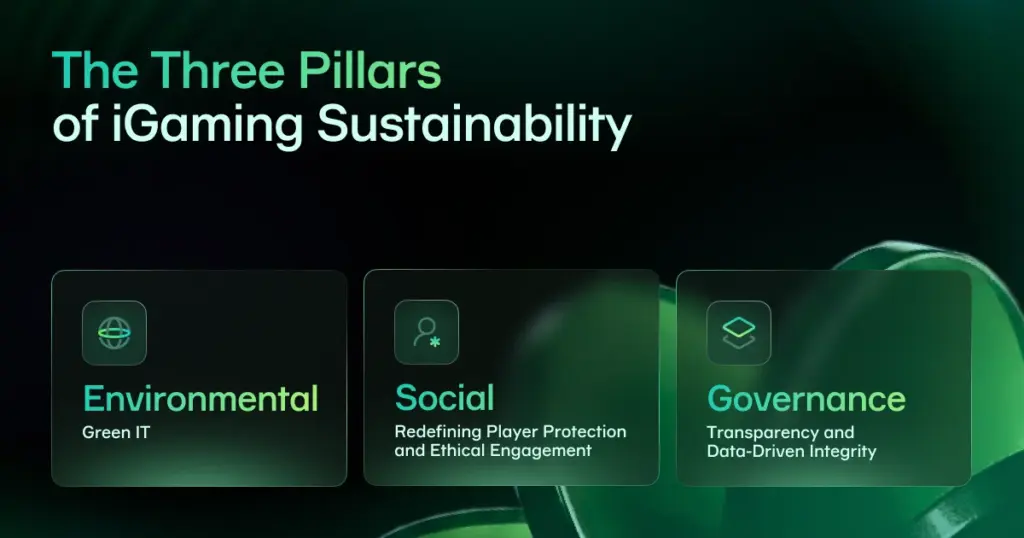
Sustainability in iGaming is most commonly examined through the lens of the ESG framework, which organises the topic across three interconnected dimensions: environmental, social, and governance.
Environmental Sustainability: Green IT
The environmental consequences of running an online gambling platform are easy to overlook, precisely because they are invisible in a way that traditional land-based operations are not. A physical casino leaves an obvious mark — energy burned on lighting and heating, waste generated by daily operations. The ecological footprint of iGaming, by contrast, is hidden from view, dispersed across sprawling server networks and data centres that never switch off.
As appetite for high-definition streaming and live data processing continues to expand, so does the energy required to keep pace with it. This reality has pushed green IT to the front of the conversation around corporate sustainability in the sector.
Social Dimension: Rethinking Player Protection and Ethical Engagement
Of the three pillars, the social dimension is widely regarded as the most critical to the industry’s long-term survival. Environmental work protects the world around the business; social work protects the people inside it — the players without whom none of it functions.
A genuinely sustainable iGaming industry is one where the pursuit of entertainment does not come at a cost to the people engaging with it. This has prompted a significant shift in how operators think about safety — moving away from reactive measures deployed after harm has occurred, and toward responsible gaming systems that are woven into the experience from the outset.
Social sustainability also shapes how companies operate internally. Commitments to diversity, equity, and inclusion within the workforce, alongside active participation in community programmes, build the kind of reputation that earns lasting confidence from players, partners, and stakeholders over time.
Governance: Data-Driven Transparency and Integrity
Governance within sustainable iGaming has undergone a meaningful transformation. What was once treated as little more than a compliance formality has become one of the structural pillars on which business stability rests. The environmental and social dimensions address what kind of impact a company has; governance determines whether that impact is being tracked honestly, reported openly, and subject to genuine accountability.
For operators in today’s market, transparency is the currency through which trust is earned — with licensing authorities, with the investment community, and with players themselves.
By 2026, ESG reporting and well-defined internal policies have become the norm rather than the exception among industry leaders. The MGA ESG Code of Good Practice represents one prominent example, giving operators a structured approach to disclosing environmental and social performance in a consistent and credible way.
Annual sustainability reports allow operators to put real numbers behind their ESG commitments — from gender pay equality and carbon reduction figures to data on the effectiveness of responsible gaming frameworks. For investors who rely on ESG metrics to assess long-term financial risk and business durability, this level of disclosure has shifted from a welcome addition to an expected standard.
Soft2Bet and Sustainable Development
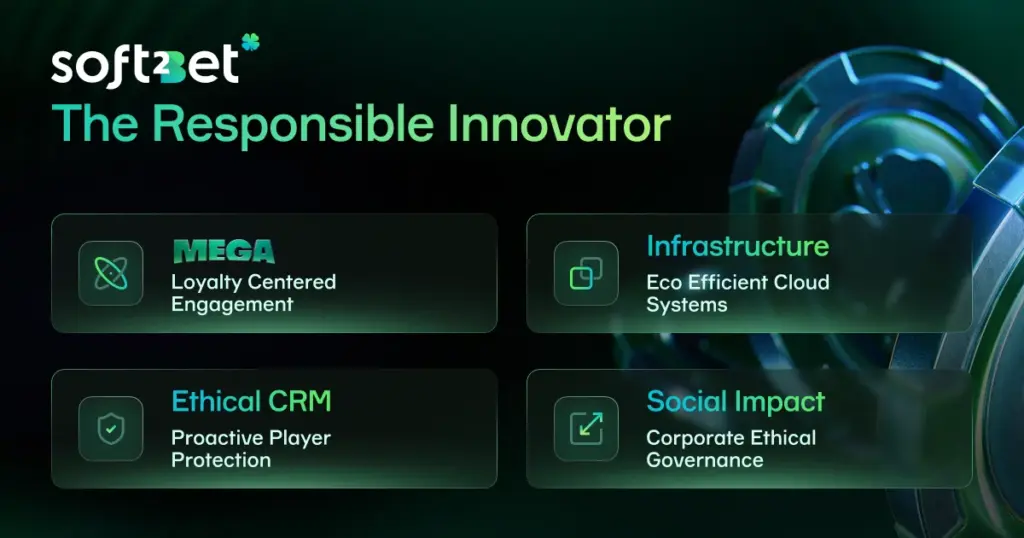
Soft2Bet has built its identity within the industry around the concept of responsible innovation, embedding sustainability across several of the pillars that hold its business model together.
- Motivational Engineering Gaming Application (MEGA): At its core, the MEGA platform is a gamification engine oriented around deepening player engagement over time. Rather than depending on promotional campaigns and bonus incentives to generate activity, it is built around sustainable models of interaction that place lasting user participation ahead of short-term results.
- Cloud-based infrastructure: Moving to cloud-based infrastructure has allowed the company to bring energy consumption down without sacrificing technical performance. This transition makes a practical case that high-capability technology and genuine environmental efficiency can coexist and reinforce one another.
- Responsible gambling through ethical CRM: Soft2Bet draws on customer relationship management tools combined with data analysis to pick up on potentially harmful behavioural patterns before they develop into serious problems. This positions the company firmly on the proactive end of player protection, rather than waiting to respond once harm has already occurred.
- Social responsibility: The sustainability agenda at Soft2Bet reaches beyond platform operations, encompassing social initiatives and charitable contributions that reflect the organisation’s broader values around ethical conduct, inclusion, and community engagement.
The Current Legal Framework
No single unified global environmental framework aimed specifically at the iGaming industry currently exists. That said, a combination of regional obligations and voluntary sustainability initiatives is steadily coalescing into a structure that operators need to engage with seriously.
For businesses in this space, the situation calls for forward-looking planning — ensuring that infrastructure choices and operational models are positioned to meet the expectations that future oversight will place on them.
From 2026, data centres operating with an installed IT capacity of 500 kilowatts or above must submit detailed energy efficiency data to a central European database.
- Large iGaming platforms are therefore required to disclose figures covering total energy consumption, power usage effectiveness (PUE), and water used in cooling operations.
- For businesses headquartered within the EU, the Corporate Sustainability Reporting Directive (CSRD) adds a further layer of obligation through “double materiality” reporting — organisations must account for both the effect of sustainability factors on their financial results and the environmental consequences of running large-scale digital operations.
Where binding global standards are absent, some licensing bodies have stepped in with voluntary frameworks designed to raise the bar across the industry. The ESG Code of Good Practice introduced by the Malta Gaming Authority (MGA) is a notable example. Although operators can choose whether or not to participate, the framework provides a structured means of reporting performance across 19 environmental, social, and governance areas.
In practice, this initiative has grown well beyond its voluntary origins. Operators who earn the MGA ESG Code Approval Seal gain a tangible advantage in their dealings with banks, insurers, and business partners who are themselves bound by European sustainability reporting standards. Holding this accreditation has increasingly become a factor that strengthens an operator’s hand when pursuing licence renewals or making the case for entry into new markets.
The direction the industry is heading in is not difficult to read. There is a broad expectation that before the close of the decade, environmental performance and sustainability credentials will be assessed as standard criteria within licensing processes — sitting alongside established measures such as Anti-Money Laundering (AML) and Know Your Customer (KYC) requirements.
- The sector may well evolve toward a “green licensing” model in which demonstrating credible carbon reduction targets or robust player protection frameworks becomes a formal part of what operators must prove to maintain and expand their licences.
- For iGaming businesses, the strategic picture is coming into sharp focus: build sustainability into operations now and stay ahead of the curve, or delay and encounter far greater costs and exposure to licensing risk further down the road — up to and including financial penalties or restrictions on where and how they are permitted to operate.
Conclusion
The road ahead for sustainable iGaming will be shaped by how effectively the industry manages to bring compliance systems, technological innovation, and ethical business conduct together into a single coherent approach.
For businesses like Soft2Bet, this transition is already well underway — with growing investment in player protection tools underpinned by advanced analytics, and a clear commitment to technical infrastructure that delivers strong performance without unnecessary environmental cost. As the wider legal landscape continues to develop and places greater demands on businesses around environmental and social accountability, the operators that carve out a lasting position will be those that have fundamentally reframed how they think about sustainability — not as an obligation imposed from outside, but as the foundation on which meaningful innovation is built and genuine trust with players, partners, and the broader industry is earned.