






Soft2Bet’s CRM-Based Model for Risk Management and Cross-Market Compliance

1. Compliance and Risk as Global Operational Priorities
Online gaming has evolved into a continuously operating, data-intensive industry governed by complex regulatory oversight. Operators must meet demanding compliance standards while also managing financial risk and protecting players from fraud and gambling-related harm across multiple jurisdictions.
Regulators are continuously updating requirements surrounding anti-money laundering (AML), Know Your Customer (KYC) verification, player identification procedures, advertising restrictions, and responsible gaming protections. In most licensing frameworks, AML obligations and responsible gambling policies are now deeply embedded, with transparency in player data handling treated as a critical regulatory expectation.
Data protection regulations have also become more comprehensive. Laws such as the GDPR establish clear requirements for lawful processing of personal information, strict storage limitations, and detailed guidelines for how player data must be collected, stored, and used.
When these regulations intersect with local requirements—such as Sweden’s national self-exclusion register Spelpaus or Ontario’s rule that player data must remain stored within the province—they create a complex regulatory landscape spanning multiple jurisdictions.
For operators, this environment requires several capabilities:
- Systems that can demonstrate regulatory compliance at any time
- Robust AML and fraud-prevention processes that scale alongside business growth
- Data-driven responsible gaming tools designed to protect players from harm
- Secure record-keeping systems that maintain auditable histories of every decision and interaction
Soft2Bet has positioned itself effectively within this environment. Operating under 23 licences, the company designs its platform so that compliance management, risk monitoring, and player experience operate within a single integrated infrastructure supported by CRM and back-office tools.
The CRM environment, player account systems, payment processing tools, and engagement engines all work toward the same objective: maintaining safe and sustainable platform growth.
2. Real-Time Risk Monitoring
Risk management in modern iGaming platforms increasingly depends on continuous monitoring rather than periodic manual reviews.
At Soft2Bet, this real-time monitoring philosophy is integrated directly into the CRM architecture and the way operational data flows across the platform.
- During onboarding, every new account undergoes KYC verification, identity confirmation, and sanctions or PEP screening.
- During gameplay, behavioural indicators – such as loss patterns, chasing behaviour, session duration, and product usage – feed into player behaviour analytics that support responsible gaming monitoring and early-stage risk detection.
- Payment transactions are also monitored continuously. Each deposit and withdrawal forms part of an ongoing transaction monitoring process supported by device intelligence and geolocation analysis to identify suspicious activity.
- Marketing and CRM systems also operate under compliance controls. Campaign tools verify responsible gaming status and exclusion lists while confirming consent before any promotional message is delivered.
CRM as the operational risk control centre
Soft2Bet’s CRM environment functions as the central hub for operational risk monitoring.
Instead of managing AML monitoring, responsible gaming alerts, payment reviews, and customer service information through separate systems, the platform consolidates these processes into a unified real-time interface.
This integrated approach allows immediate responses:
- Suspicious payment behaviour automatically updates a player’s AML risk score
- Responsible gaming alerts can pause promotional offers or adjust rewards eligibility
- Failed identity verification can immediately prevent further gameplay or restrict withdrawals
Combining automation with expert oversight
Regulatory authorities increasingly expect operators to combine technological monitoring with human judgment when handling compliance and responsible gaming obligations.
Soft2Bet’s back-office systems are designed around this principle.
Case-management dashboards bring together all relevant CRM activity into a single operational view. Each decision is supported by time-stamped records that provide transparency for regulatory audits.
Risk thresholds can also be customised so that each licensed market operates with its own regulatory parameters embedded directly within the CRM system.
Because all of these processes function within one unified environment, the platform supports continuous 24-hour risk monitoring. Automated tools perform routine checks while specialised teams focus on cases that require human evaluation or intervention.
3. Managing Compliance Across Multiple Jurisdictions
As Soft2Bet continues expanding its brands into additional markets, compliance with regional data regulations becomes just as critical as the gaming services themselves.
Each licence introduces specific rules regarding:
- Data localisation requirements defining where player information must be stored
- Retention periods for KYC and AML documentation
- Access permissions controlling who can process personal data
- Procedures for handling self-exclusion records and responsible gaming information
GDPR principles and data retention policies
Under GDPR regulations, operators must process personal data transparently and lawfully while ensuring that information is not stored longer than necessary.
For gaming platforms, this requires structured retention policies covering KYC documentation, AML investigation records, and responsible gaming data.
It also requires mechanisms to ensure that personal information is deleted or anonymised once regulatory retention periods expire while maintaining records proving that these processes have been followed.
Soft2Bet’s CRM architecture allows retention periods to be defined at the individual data-field level. Identity documents, payment records, gameplay logs, and responsible gaming notes can all follow the specific legal requirements associated with each jurisdiction.
National regulatory frameworks in Sweden, Ontario, and Romania
In addition to broader regulatory frameworks, national regulators impose their own requirements.
In Sweden, operators licensed by Spelinspektionen must integrate with Spelpaus, the country’s national self-exclusion register. This system blocks excluded players from accessing licensed platforms and removes them from gambling-related marketing communications.
In Ontario, regulatory bodies such as AGCO and iGaming Ontario require operators to store player data within provincial boundaries while protecting it from unauthorised access. Operators must also provide anonymised information used for responsible gaming monitoring and research.
Romania’s regulator, ONJN, requires certified monitoring systems that allow regulators to access transaction data and financial records in real time.
Soft2Bet’s proprietary platform infrastructure was developed to manage these varying regulatory requirements without needing major system redesigns for each new market. Instead, the platform uses a flexible architecture capable of adapting to local licensing frameworks and regulatory rules.
CRM-supported compliance across jurisdictions
In practical terms, the platform allows each market to operate under its own compliance structure within the same technological framework.
KYC procedures and identity verification follow local requirements for age verification, residency confirmation, and affordability checks.
AML risk scoring and case management processes follow the guidelines defined by each relevant authorities
Responsible gaming alerts and self-exclusion records are stored according to jurisdiction-specific retention timelines, while interaction histories follow the same rules.
Access control systems ensure that operational teams only view the information required to fulfil regulatory obligations.
The CRM system also supports multi-currency functionality and market-specific payment routing. Back-office tools allow operational teams to manage payment limits and currencies depending on the regulatory environment.
This allows Soft2Bet to maintain a consistent player experience across multiple brands while meeting the specific compliance requirements of each gaming licence.
4. Technical Failures and Their Impact on Platform Compliance
Technical stability is sometimes overlooked when discussing iGaming compliance. However, platform reliability plays a crucial role.
When technical failures affect game fairness or compromise systems designed to protect player data, they can quickly escalate into compliance incidents with regulatory consequences.
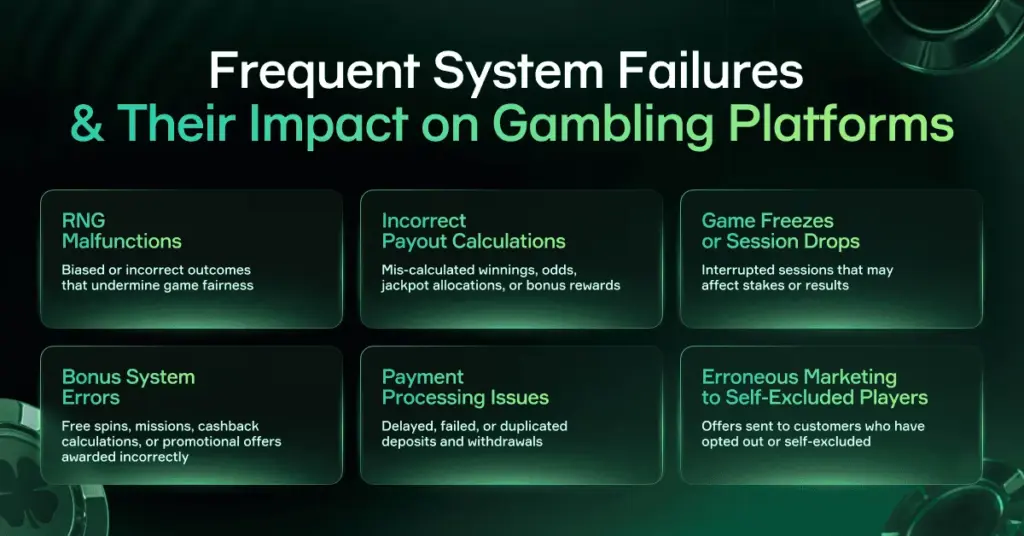
Several types of technical failures can occur on gambling platforms, including:
- RNG irregularities: situations where random number generators produce incorrect or biased outcomes, which may compromise game fairness.
- Incorrect payout calculations: errors in the calculation of winnings, odds, jackpot distribution, or other rewards.
- Gameplay interruptions or dropped sessions: technical disruptions that pause or terminate gaming sessions and may influence bets or final outcomes.
- Payment processing problems: deposits or withdrawals that are delayed, duplicated, or fail to process correctly.
- Promotional messages sent to excluded players: marketing offers mistakenly delivered to players who have opted out or activated self-exclusion.
Designing systems for reliability and traceability
Soft2Bet’s platform architecture prioritises uptime, fast response performance, data accuracy, and resilience to system failures. Company leadership emphasises that platform reliability is a fundamental part of long-term business sustainability rather than a background technical function.
The CRM-based infrastructure supports incident handling in several ways:
Comprehensive activity logging
All platform activities—including gameplay sessions, wagers, payouts, promotional rewards, and payment transactions—are recorded across the CRM and supporting systems. This creates a detailed audit trail that can be reviewed whenever operational issues occur.
Rapid incident identification
If a malfunction occurs in a game or promotion, back-office tools allow teams to quickly identify the affected players and jurisdictions. Product-level filtering helps operational teams determine the scope of the problem and apply account adjustments before reporting the issue to regulators.
Suppression of restricted offers
The CRM system enforces suppression lists for players who are self-excluded or classified as high-risk. This reduces the possibility of sending promotional messages or cross-selling offers that could violate compliance rules.
Platform security and data protection
Security measures such as role-based permissions, encryption protocols, and clear separation of responsibilities help prevent unauthorized changes to sensitive information. These protections support strong standards for both data protection and system security.
Together, these safeguards enable Soft2Bet to detect problems early and resolve them efficiently, while maintaining detailed documentation for regulatory reviews. This strengthens overall risk management and helps maintain stable licensing conditions.
5. Integrating Risk Management, Responsible Gaming, and Compliance
Across Europe and other regions, industry reports indicate record levels of usage for safer-gambling tools and an increasing number of safety messages delivered to players. These developments demonstrate that responsible gaming has become a central component of regulatory compliance in iGaming.
At the same time, studies on behavioural analytics and predictive modelling show how operators can use real-time data to identify early signs of harm and respond more effectively.
Data governance as the foundation
Strong data governance connects risk management, responsible gaming practices, and compliance requirements into a single operational framework. When implemented effectively, this approach provides several advantages:
- Early risk identification: gameplay behaviour, payment activity, and CRM data can be analysed together to detect unusual patterns in near real time.
- Regulatory transparency: clearly documented rules and consolidated case records simplify oversight and audit processes.
- Responsible marketing practices: CRM segmentation respects responsible gaming status, affordability alerts, consent requirements, and communication limits.
- Improved player protection: interventions occur earlier and are properly documented.
- Stronger AML and fraud detection: the same datasets help identify collusion, bonus abuse, money-laundering behaviour, or account takeover attempts.
Soft2Bet’s internal structure is organised around this integrated model. Responsible Gambling and Compliance teams define policies and thresholds, while product and engineering teams implement these rules directly within the platform infrastructure.
Marketing and CRM teams are also expected to respect exclusion rules and communication consent requirements, particularly when interacting with vulnerable player groups.
CRM systems designed around player care
CRM strategies in modern iGaming are gradually moving away from mass promotional broadcasting toward more personalised and responsible communication.
Industry experts note that segmentation must be combined with orchestration tools and AI-driven analytics in order to integrate responsible gaming and compliance rules effectively.
Soft2Bet’s CRM system follows this direction by analysing not only player value and preferences but also responsible gaming indicators and AML risk signals.
Campaigns can respond dynamically to behavioural changes. For example, promotional messaging may automatically switch to safer-play reminders if risk indicators appear.
Back-office tools also help support agents select appropriate communication strategies when interacting with vulnerable customers.
6. Soft2Bet’s approach to risk reduction and player protection
Soft2Bet’s compliance framework forms part of a broader operational model in which risk management, AML monitoring, responsible gaming policies, payment systems, and product development are integrated through a shared CRM environment.
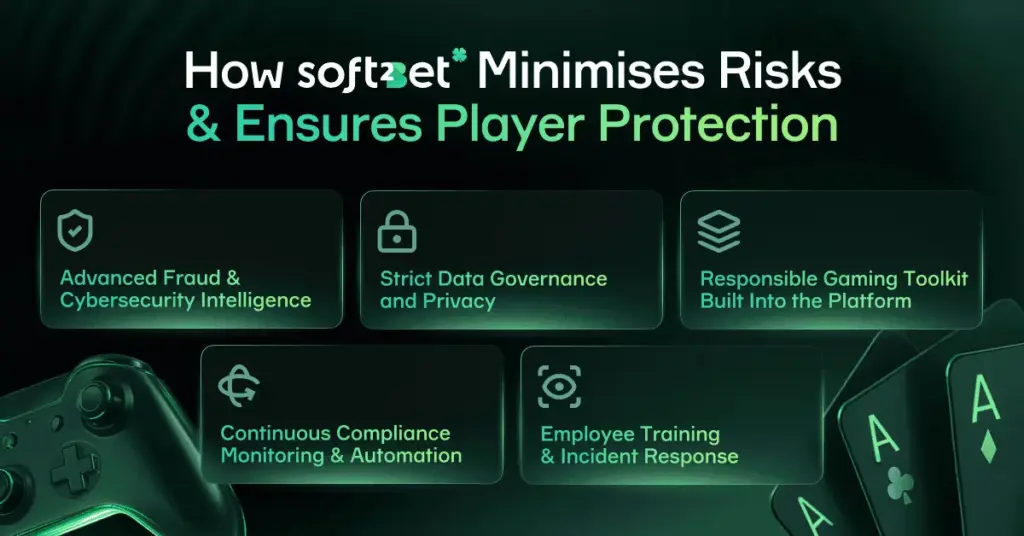
By relying on a unified view of the customer across departments, the platform ensures that compliance checks, operational decisions, and player protection measures remain aligned throughout the system.
6.1 Advanced Fraud Detection and Cybersecurity Intelligence
Soft2Bet applies a layered security framework that combines anomaly detection, device analysis, and behavioural scoring to identify suspicious activity across all stages of the player journey, including registration, login, gameplay, and payment activity. Core components of this approach include:
- Real-time transaction analysis, which monitors unusual betting volumes, rapid withdrawals, risky payment methods, and abnormal spending patterns.
- Velocity monitoring and device fingerprinting, helping detect suspicious behaviour such as bot-driven activity, bonus abuse, identity theft attempts, and automated multi-account registrations.
- IP and geolocation verification, ensuring compliance with cross-border licensing rules by identifying restricted territories or blocked product categories.
- Ongoing optimization of risk thresholds, using historical CRM data to continuously refine fraud detection rules.
These safeguards operate alongside Soft2Bet’s broader platform security framework. Access management controls, encryption standards, secure software development procedures, and audit-oriented configuration practices work together to protect both financial transactions and personal data.
6.2 Robust Data Governance and Privacy Protection
Soft2Bet’s data governance framework aligns with GDPR requirements related to storage limitations and data accuracy, as well as jurisdiction-specific data-storage regulations across key markets.
Within the CRM environment and its supporting systems, all information related to KYC verification, AML monitoring, payment processing, marketing operations, and responsible gaming controls is clearly categorised. Market-specific retention policies ensure that KYC documentation, AML records, and responsible gaming notes follow the legal timelines required in each jurisdiction.
Access control mechanisms reinforce these principles by ensuring that employees can only view the data necessary for their specific responsibilities. This approach supports clear separation of duties and helps prevent inappropriate data access.
Regular internal reviews verify that procedures related to data deletion, archiving, and access control operate according to policy.
By prioritising both privacy and security, Soft2Bet maintains strong trust among regulators and players while ensuring that personal data remains securely managed within a controlled operational framework.
6.3 Responsible Gaming Tools Integrated Into the Platform
Responsible gaming principles are embedded directly into Soft2Bet’s technology and engagement strategy. Internal policies emphasise a “players first” philosophy supported by multiple tools such as self-exclusion systems, deposit limits, session management controls, and AI-based risk evaluation.
Through the CRM environment and the front-end platform, operators using Soft2Bet technology can:
- Configure deposit and loss limits based on the regulatory requirements of individual markets.
- Offer self-exclusion and cooling-off options aligned with national programmes such as Sweden’s Spelpaus or similar initiatives developing in Ontario.
- Trigger behavioural alerts when player activity indicates potential risk patterns, such as chasing losses or increasing gameplay speed.
- Structure CRM communication flows that prioritise support messages and reminders instead of promotional offers for at-risk players.
This environment also integrates closely with Soft2Bet’s MEGA (Motivational Engineering Gaming Application).
MEGA uses behavioural segmentation and gamification mechanics to organise missions, challenges, and reward systems. When linked with CRM signals related to responsible gaming and AML monitoring, the system allows operators to:
- Adjust promotional offers when early risk indicators appear.
- Maintain engagement among high-value but stable players through non-intrusive challenges and reward systems.
- Introduce “healthy play” missions that encourage breaks, budgeting, and responsible gameplay habits.
Soft2Bet and its brands have received several industry award nominations related to MEGA and their performance, highlighting recognition of this balanced engagement model.
6.4 Automated Compliance Monitoring and Ongoing Regulatory Oversight
As regulatory frameworks evolve across jurisdictions, Soft2Bet invests heavily in automated compliance systems and continuous monitoring technologies.
Processes such as KYC verification, AML monitoring, and broader compliance checks rely on automated document verification tools, sanctions database screening combined with PEP monitoring, anti-fraud rule engines, and configurable risk scoring systems.
Operationally, this enables:
- Automated compliance checks during onboarding, withdrawal requests, account modifications, and profile updates.
- Customisable rule engines that apply jurisdiction-specific requirements, such as varying source-of-funds thresholds across different markets.
- Reporting dashboards and regulatory data exports aligned with local supervisory authority requirements.
- Smart alert systems that initiate investigations when unusual activity appears in areas such as transaction monitoring, self-exclusion activity, chargebacks, or player complaints.
This automation enables Soft2Bet to adapt quickly to regulatory changes across multiple jurisdictions. Compliance rules can be updated centrally and applied consistently throughout the platform.
As the business expands, this model ensures that risk management and regulatory compliance scale effectively without slowing operational processes or creating inefficiencies for regional teams.
6.5 Staff Training and Incident Response Procedures
Even advanced technology requires knowledgeable teams to operate effectively. Soft2Bet therefore places strong emphasis on continuous staff training in areas such as AML compliance, KYC procedures, data security practices, and responsible gaming principles.
Collaboration between Compliance, Responsible Gaming, Product Development, CRM, and Customer Support teams ensures that operational knowledge is shared across departments.
Regular training programmes support both frontline staff and specialised teams. Incident-response frameworks guide employees when managing fraud investigations, potential AML violations, responsible gaming escalations, or data protection incidents.
Following each incident, internal reviews help refine operational procedures, risk thresholds, and CRM rules within the platform’s back-office environment.
Soft2Bet’s organisational culture balances rapid learning and adaptability—often associated with startup environments—with a strong regulatory mindset that is essential for operating within highly competitive markets.
7. Compliance and Data Governance as Drivers of Sustainable Growth
Across the iGaming industry, experts increasingly recognise that regulatory compliance can become a competitive advantage when implemented strategically.
Studies in customer support and platform management show that operators who treat compliance—particularly responsible gaming and data protection—as a foundation for trust often create stronger player relationships and more resilient brands.
Soft2Bet’s experience across multiple markets reflects this development. The company has observed that clearly defined operational processes supported by data-driven insights help create safer gaming environments while also strengthening internal stability.
A unified CRM and back-office framework allows teams to apply compliance controls consistently across jurisdictions, while strong data governance practices increase confidence among the wider industry ecosystem.
The MEGA platform integrates naturally into this structure because its engagement model operates within responsible gaming expectations rather than conflicting with them.
Soft2Bet follows this strategy by developing technology designed for regulatory clarity, providing engagement tools that respect self-exclusion and affordability limits, and structuring payment systems and multi-currency functionality around local market conditions.
Across the organisation, the same principle applies: ensuring that compliance and business growth remain aligned rather than treated as separate objectives.